Showing posts with label Kathmandu. Show all posts

Saturday, April 7, 2018

Day 20: Kathmandu


Today was a lazy, mostly uneventful day.  We didn’t have anywhere we were supposed to go, no destinations, projects, or necessary activities.  I’d build this extra day into our schedule to ensure that we were safely in Kathmandu, in case the bus broke down from Pokhara or some other disaster befell and delayed us: I didn’t want to miss our flight home!  Happily, our travels met no such calamity – except for a brief scare when we heard that all the taxi drivers were going on strike today, as well as a great many businesses in the area: after further inquiry, my informant, a smiling and chatty English-speaking Nepali, said the strike should only last today and we shouldn’t have any difficulties getting to the airport in the morning.


This spare day wasn’t as enjoyable as our rest day in Tatopani, because there was no comparing that lush, tropical vacation destination to the noisy, congested, smog saturated city of Kathmandu.  We decided to go for a walk to find breakfast and we found a quiet, plant decorated place called Revolution Café and enjoyed our last Set breakfast as we sat under their awning-covered patio/alleyway and watched trekkers and motorbikes navigate the narrow street.  Since we didn’t have anywhere to go after breakfast, we window shopped to waste time and wandered up and down every street in Thamel.  I decided I must own a pair of the flowing harlequin pants I saw on every third female trekker that passed us, so, with a mission now, we stopped to shop every single clothing vendor – there were dozens upon dozens of them.  Lunchtime arrived and we returned to our hotel to spend a lazy lunch on the roof balcony, eating fries, drinking hot cocoa, and watching the flow of pedestrians and bikes and carts on the street below us.  Our food was edible, though I believed we would get sick, because I was sure they were not properly boiling the water used in our drinks and to cook our meals.

These birds were everywhere and have a horrendously annoying caw.

Photo fail: my camera took a self-timed photo and started to fall off the table. Yes, totally eating fries with toothpicks.

The water tanks breed confidence, right?


After reading and napping in our room we hit the even more congested streets to shop and find dinner.  I eventually gave up my pants mission, finding nothing long enough to fit my body, so we navigated back through the twisting, branching streets to the popular Roadhouse Café to try their famous woodoven cooked pizza.  The place was packed full of people, but we managed to score a table on their back patio and within eyesight of the ovens.  It was an entertaining place to people watch and listen to all the different languages represented, but the service was lousy and the food, while tasty, was expensive.  We finished our meal, lingered, waited for our bill, asked for our bill, and waited some more.  Hoping to draw our not-that-busy waiter’s attention, we stacked our dishes like the leaning tower of Pisa: it did not have the desired effect.  Finally we stood up and pretended to leave, which immediately garnered his service.  We made our way back to our hotel just as darkness was falling over the still bustling city, climbed the three flights of poorly lit stairs to our room, and prepared for bed.  Earplugs were a must.

Friday, April 6, 2018

Day 19: Pokhara - Kathmandu


The alarm started beeping and we immediately packed and hit the road.  Most all the shops were closed and the streets nearly deserted at such an early hour, but the boys with huge platters of pastries balanced on their heads were out trying to sell breakfast to early risers like us.  We bought cinnamon rolls from one of them and I didn’t let myself think about the sanitation status of my roll.  Then, happily, we found an open coffee shop and ordered hot chocolate – I was briefly worried that the shop wouldn’t have to-go cups, but they must have been accustomed to trekkers needing a warm drink on the go as they walked to the bus stop, so I was pleased when the girl nodded at my paper cup request.  Breakfast in hand, we retraced our steps from yesterday’s reconnaissance walk and had an easy, flat walk along the road in the cool morning air.  As we grew closer to the bus stop, more and more trekkers could be seen, either walking like us, or bumping along in tiny taxis: it was as if we were bees returning to a hive or metal shards being drawn to a magnet.


Waiting for hot chocolate.

One final look at Annapurna South.

Goodbye


Some sort of blessing: the two women walk and pour stuff around a sacred tree

If we were newbie trekkers, the bus stop would have caused much trepidation and worry, because it appeared chaotic, unmarked, completely random, and devoid of any direction, however we were now seasoned Nepal travelers and were undaunted when we arrived at the enormous gravel parking lot.  Taxis dropped off their passengers and heimliched backpacks from their trunks in any open area of the dusty space, leaving the soon-to-be bus passengers blinking away the dust and gathering their bearings.  A couple of fruit and drink stands were clustered together in one corner of the lot and an army of buses was lined up, row behind row, across a wide expanse of gravel.  We sat and waited.  There was a calm hush and then, all at once, the place burst into activity, with bus managers and door boys ushering trekkers and tourists and locals toward the parked buses; we followed the flurry of activity, asking one bus manager and then another to point us toward our bus, which was identified by a name and number, but impossible for us to locate in the multitude of rows of vehicles.  Eventually, we found our bus, showed the door boy our tickets, and then stood by the vehicle waiting to climb aboard.  After the bus manager was satisfied he had collected all his passengers, he yelled for everyone to find their seats.  We, tired of standing in the already warm sun complied, only to discover our driver was missing.  Fuming, the manager stormed off the bus and a great deal of angry words could be heard above the din of rumbling bus engines, crying babies, talking passengers, and the crunch of gravel as the procession of buses began pulling out of the parking lot.  Our sheepish driver appeared, just in time for our bus’ turn to exit the lot – really this procession was beautifully choreographed, with each vehicle swinging wide to avoid collisions and sweeping across the lot with nary a snarl or traffic jam.

The buses are parked at least three rows deep.  Here you can see trekkers and taxis, as well as a fruit stand.


So we rode.  Our seats, it turned out, were excellent, as promised.  From time to time Sam and I would treat ourselves to a slice of cold pizza, while the passengers around us cast envious glances at our food selection and forethought.  The bus stopped only twice, for brief rest stops: the door boy would let everybody out of the bus and when it was time to leave, he would usher everybody back on the bus. There was a great crowd gathered in one of the towns for some sort of demonstration and protest, which slowed our progress as the bus cautiously plowed through the crowded street.

Waiting at a rest stop.

A protest of some sort.

Those flags...


I will explain here what a door boy is, since I mentioned this position yesterday as well.  Buses seem to have three people who operate them: the manager (leader), the driver (second in command), and the door boy (least).  The manager serves as the bank, the navigator, and makes most all decisions.  It isn’t difficult to figure out what the driver does.  The door boy is usually younger; he sits at the door and is in charge of opening and closing the door and helping passengers on and off the bus – he also serves as the gofer.  As we neared Kathmandu and the road began to twist and wind its way up the hillside, traffic snarled and periodically came to a standstill.  During one of these standstills, the driver ordered the door boy to get out and run up the road and see what was going on (or something to that effect, it was all said in Nepali).  So the door boy ran and came back and reported his findings.  At the next stop, a long one, the door boy got out again, as did a male passenger seated somewhere in the middle of the bus.  Many people got out of their vehicles, the wait was so long, and they were chatting with each other.  Traffic began to roll again, so the door boy hopped back in and we traveled up the road for at least ten minutes before someone from the middle or back of the bus said (all in Nepali, remember), “Hey, where’s so-and-so?”  A slight commotion rustled its way up through the bus as people started asking about the male passenger who got off the bus.  “Is he up front?”  We up front shook our heads no.  The manager now caught wind of the murmurs and, I kid you not, the following Nepali conversation was as understandable as if they were speaking English:
Manager: “What’s going on?”
Door Boy: “They are saying So-and-So isn’t on the bus.”
Manager: “What? Where is he?”
Door Boy: “So-and-So got off the bus when we stopped and I guess he didn’t get back on.  We left him.”
Manager: “Ugh, can you see him behind us?”
Door Boy, after smashing his head against the door’s window and looking behind us: “No, I don’t see him.”
Manager: “Oh well, it’s too late now: we aren’t stopping.”
Driver: “No freaking way are we stopping for that idiot.”
Sam and I looked at each other and burst into laughter.

Traffic, an ambulance, and um...our driver's head.
  
The bus completed it’s journey at a bus stop that was different from the one we had been at when we left Kathmandu, so Sam and I had zero clue where we were or in which direction was Thamel.  This fact caused me not the slightest trepidation.  I started walking down the sidewalk and stopped people whom I thought were likely to either speak English or be able to point me in the direction of Thamel.  I made a couple of attempts, asking “Thamel?” until one man pointed up the road and then curved his hand to the right.  Sam and I followed his directions, made a couple smart guesses, and knew we had arrived when we began to see colored prayer flags strung across narrow streets and cheap trekker supplies in shop windows.  I reflected back to that first day when we followed the white girl who was so relaxed and seemed to know where she was and what she was doing; I proudly realized I was that girl now.


Relaxing with my feet up, because I just completed an awesome trek.

Sam and I wandered the streets looking for a suitable hotel and asked around at a couple of places – I wanted something under $5.  We settled on one place, mostly because we were tired.  They had a restaurant up on the top floor and we ate dinner there: I had fries, which had become my main dish of choice.  Then we spent the rest of the evening reading and listening to the garish sounds of the busy city of Kathmandu.

Monday, March 19, 2018

Day 1: Kathmandu-Bhulbhule

Wake-up time was 5:30am and it didn’t take us long to pack and be ready to leave.  With a few minutes to waste, we went up to the roof and took photos from the top of Hotel Nepalya.

Ready to begin the day!

Then, we climbed down the six flights of stairs to the front desk and asked for our bus tickets.  It was the same boy who sold us the tickets last night, but he asked us if we’d paid for them.  I told him: “I paid you last night!” Such a scam.  Sheepishly, he handed over our tickets and waved us in the general direction of the bus park.

The sign for our hotel is on the blue building, above the biker, but the hotel is down the alley.

At about 6:15am we left the hotel.  There was a thick layer of wet dirt covering patches of the concrete streets and a mixture of rubble, stones, and general trash littered the ground.  It was tricky walking.  We picked our way through the rather deserted streets and winding alleys in the assumed direction of the bus park and sort-of just followed the flow of the few pedestrians who seemed to be headed to the same place as part of their morning commute to work.  I was sorry we didn’t have breakfast, but we had left too early for the free continental breakfast that the hotel supposedly provides.  Within about 10 minutes, we reached the bus park: a very, very, long line of buses parked along the side of a busy street.  Of course, we had to cross the street to get to the buses.  All of the buses were marked by numbers in their windshields, but nobody seemed to know the bus numbers; instead, they referred to the busses by name.  Our bus name was “Holiday” something.  Since we were standing at about the middle of the bus line, we didn’t know if we should walk up or down the line and I started to have a sinking feeling about missing our 7:00 bus departure.  Several men accosted us, trying to sell us bus tickets (apparently buying tickets the night before was unnecessary), but they left us alone after I said we already had tickets.  One rather important looking man, who was issuing orders to dozens of scurrying men, paused his task and motioned as if to ask to look at our tickets – we must have looked pitiful standing there not knowing what to do – and then he personally escorted us up the line and showed us our bus; all this without speaking a word of English and continuing to bark his orders to the jumble of men and boys milling all around us.  It was a tumultuous scene.  Trekkers and locals jostled one another as they made their way between buses, workers flung a wide assortment of bags and packages and boxes up on top of the vehicles while other men stood up on top to catch everything and tie it securely with ropes, stray dogs barked, cows lazily wandered down the sidewalk, a rooster crowed, and the beep of mopeds steadily increased in number.

At the bus park.

We boarded our bus bound for Pokhara, found our seat numbers, and kept our backpacks with us by placing them in the space where our legs should have been.  Sam sat sideways and I sat with my legs bunched up on the seat.  I’d read that trekkers very often have their bags robbed if they are placed up on the roof.  The bus, full of passengers, left at 7:03am.  There was much honking and we made one other stop at another bus park for a couple of minutes, perhaps to get fuel.  I was so happy to be leaving Kathmandu and get away from the noise and the inglorious smells.

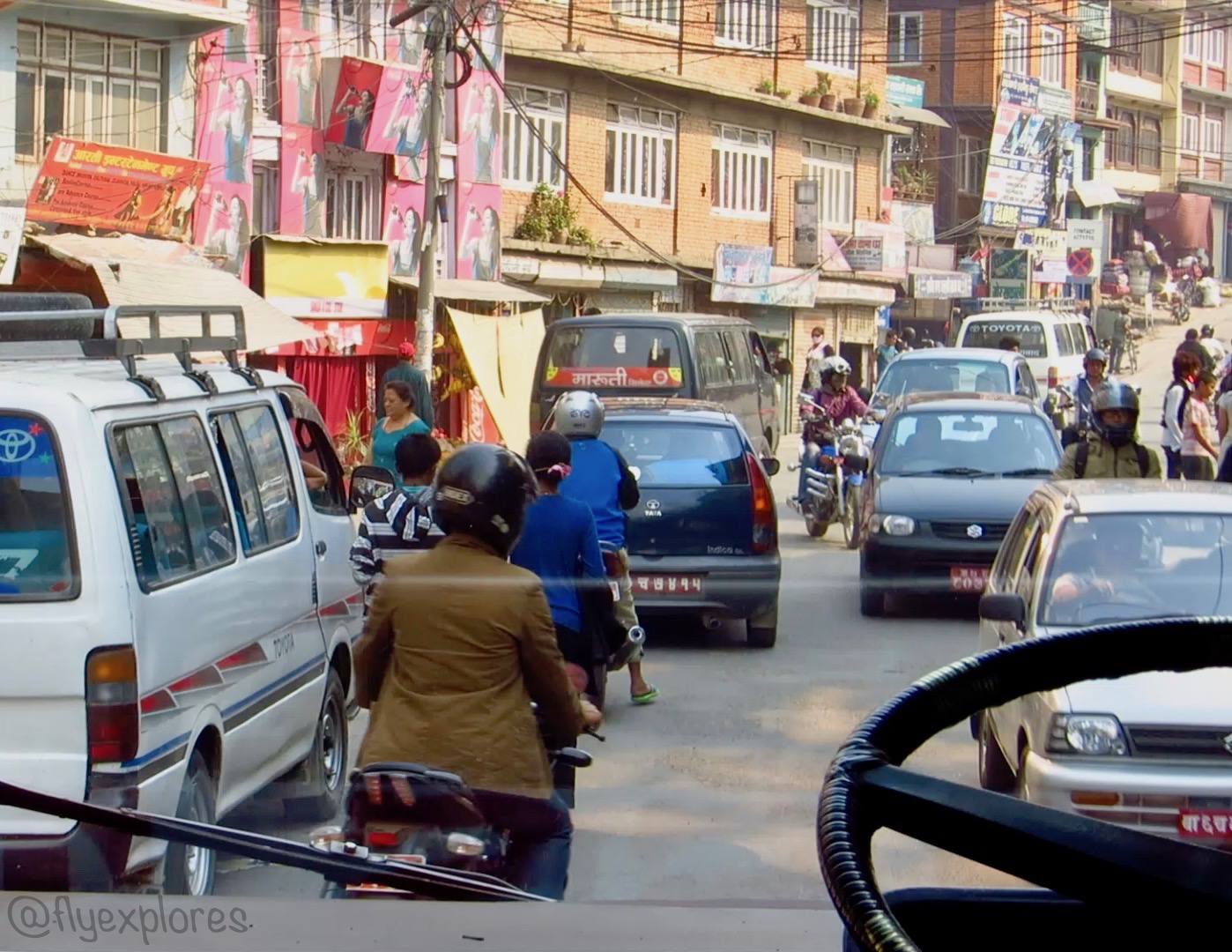
The streets are chaotic.

It took an hour to leave the city behind us and then we were immediately in the hills and cliffs.  Happily for me, a window seat passenger, they drive on the left hand side of the road and so we weren’t on the cliff edge side of the road: unless we passed something or someone.  I was able to observe that they really only honked their horn if they were going to pass something (bike, person, vehicle) or if there was an especially tight corner.  The problem is that there was constant passing and being passed and the road so curvaceous that the honking was essentially nonstop.  I also noticed that all the motorbikers wore helmets, but just the drivers.  Must be a law.

See the road up there on the right - sooo many switchbacks.

I passive-aggressively fought with the Indian guy in front of me who kept trying to recline his seat back.  However, the seats were so closely set together that his seat back would have crushed my pack or knees.  So, every time he made an attempt, I would push his seat forward to prevent him from leaning.  I garnered a great many backward glares from him, but I didn’t care in the slightest.  Other than that, the ride was uneventful.  We stopped twice at little roadside stalls to use pit toilets and for the other passengers to purchase food in the form of potato chips, fruit, and warm bottles of water and soda.  Sam and I ate some of my dehydrated bananas and rhubarb fruit leather and drank from our airplane provided water of yesterday.

At 11:30 we arrived in Dumre.  Sam and I had been a bit fearful that the bus wouldn’t stop and would simply keep going all the way to Pokhara, but thankfully the bus did stop and we bailed out with our backpacks bumping back and forth up the crowded aisle as we set ourselves free from the confines of the vehicle.

We were the only people from our bus who got out at Dumre; this again gave me a twinge of fear.  It was a little scary to be on our own and not able to simply follow the crowd.  We stood there, on the concrete platform, in the glaring sun, with tan dust swirling all around us.  I don’t know where the dust came from, because everywhere I looked off the platform was dark mud – there was literally a large spotted pig wallowing at the base of the platform, squealing with delight as it wriggled back and forth in the stinking filth.  The townspeople simply stared at us and then went about their business.  I turned around in a full 360*, as if that would help me get my bearings, and magically, a man appeared and said there was a bus leaving for Besisahar (our destination) in a half hour.  He said the ticket price was 650 each and he led us down the street and around the corner to a colorful little bus.  Sam paid him and we climbed aboard the empty vehicle.  We knew we’d paid too much, but we didn’t care: we were just happy to be where we needed to be.  Also, we ended up not having enough small bills, so we ended up only paying 630 each.

Sam, happy to be on board our second bus.

Again, we kept our packs with us and our man kept telling us to not let anyone put them up on top of the bus.  No problem there, buddy.  By 12:05pm the bus was filled completely full of local people of all shapes and sizes and smells and we began our drive.  I think there was even a small goat with us.  The bus stopped every mile or so to let people off and put people on; somehow more people got on than got off and sweaty bodies were spilling out the windows and door and riding in each other’s laps and along the aisle.  It was great fun, with people yelling from the back that this was where they wanted to stop and then everyone passing the message up to the driver, or someone had forgotten to pay and the money would be passed from hand to hand up to the front (they were only paying 45, so yeah, we totally got ripped off).  I couldn’t see Sam, since he was against the window on the opposite side of the aisle from me, with about 8 or 9 people between us on the room-for-two bench seat, but I could see a white man sitting up at the front of the bus, riding backward and talking to someone.  Hmm, possibly another trekker, I thought.


Right on time, we arrived in Besisahar at 2:00 in the afternoon.  We oozed out of the bus doors and stood in the dirt, gasping for fresh air like fish out of water.  Only two other people flopped out of the bus with us: the white man and the short, young Chinese girl he had been talking to on the bus.  I began to chat with the man as we were all bent over our backpacks, repacking and tying shoelaces.  He and the girl had only met on the bus and were going our way, so we started as a group up the tan dirt road, trying to figure out where the beginning of the trail was.  We walked straight down the middle of the main town road, traffic consisting of only a couple of bicycles, and I decided to send my first SPOT signal.  I rummaged and brought it out from its Ziploc cocoon and walked down the street with the SPOT in my hand - my hand and arm held straight up in the air, like an antenna, trying to get a good satellite signal.  Eventually, uncertain that I’d been successful in sending a signal, and because all the blood had left my arm, I turned the SPOT off and returned it to my pack.  We finally found the TIMS checkpoint, in a little bookstore, where we registered and tried to get directions.  The non-English speaking TIMS officer, irritated with our presence having interrupted his nap, was not interested in giving us accurate directions and merely waved in the direction out the other side of town.  So we continued and finally found the suspension bridge that marks the start of the Annapurna Circuit.

So we begin to trek the Annapurna Circuit!

As we were crossing the bridge, we came upon an ancient and very grumpy old woman in brightly colored clothing sitting cross-legged, smack dab in the middle of the footbridge, about ¾ of the way across.  She yelled something unintelligible at us as we approached her and flung her arm at us, indicating she wanted us to turn around and walk down the road.  We refused.  After squeezing past her, we consulted my maps and guidebook for assurance.  We are following the New Annapurna Trekking Trails which avoid the road as much as possible, so we were indeed on the correct path.  We were pretty sure, anyway…

Looking back at Besisahar and the road we had just walked before the suspension bridge.

Immediately after the bridge, stone stairs climbed steeply up the hillside.  We followed the path until it diverged and we were again in a quandary.  We took the steeper and wider route, but after 5 minutes of climbing, it didn’t look like the path would drop down to the second suspension bridge that we could see below us and that we needed to cross, according to our guidebooks.  So, we backtracked and took the lower, smaller path.  This path was fine until it disappeared all together and we were forced to make our way through some terraced gardens and people’s backyards (sorry) and then eventually met with our original trail as it descended.

Hot, but happy!

A combination of humidity and 90*F heat, did not mix well with the cotton I was wearing as my travel clothes.  I told the others to go on without me and I did something I’ve never done before in my life: took off my shirt, right there in public, and changed into a different shirt.  Public, might be a stretch, since I didn’t see anyone amongst the trees and terraced rice fields, but I was completely exposed to anyone who might have been looking in my direction.  Usually modesty is high on my priority list, but not today – I simply didn’t care.  I left my travel shirt sitting right there beside the trail for some local to add to their wardrobe; feeling much cooler, I rejoined my merry band of trekkers.  They were taking a break along the road and I sat on a rock and changed out of my cotton travel socks and into my wool hiking socks, narrowly avoiding the creation of a blister on my toe.  When we started hiking again, the cotton socks remained on the rock.

On the trail to Bhulbhule.

We crossed another suspension bridge and followed the trail as it wound up and down the mountainside until we finally came to Bhulbhule at 5:45pm.  There was a bit of confusion when we neared town because we didn’t know if we were supposed to cross a suspension bridge that diverged from the trail or not.  The main road was across the river and we decided we didn’t want to be near it, in case of noise, so we continued straight ahead and stopped at the first place we came to, which happened to be a teahouse overlooking the river.  Usually I am on the lookout for the best deal, but I’d read that teahouses are regulated and the prices they charge are all about the same, so I didn't feel compelled to shop around at other teahouses. Also, I was bone tired.  The proprietor led our group up the craziest, steepest staircase I have ever witnessed to show us the rooms.  I claimed the first room we came to that faced the river, not the trail/street; hoping the sound of the river would be sleep inducing.  The walls of the building consisted of plank boards with gaps between them.  I could see into the room adjoining ours, as well as into the hall, the stairwell, and the outside world.  Privacy, what’s that?  I was glad my inhibitions about changing in front of people had diminished earlier in the day.  Our room was just long enough to fit a single bed and wide enough for a two foot path from the door, with a single bed on either side.  It was cramped with two people and two backpacks: we could not both be standing up at the same time and neither of us could stand at all with our packs sitting on the floor.  But there was a window and a poster that said “Nepal” so I was feeling totally awesome about being there and being a trekker.

Our room - you can see daylight in the gaps between the plank walls.

Our room view of the river and that confusing suspension bridge.
The crazy steep staircase - super challenging with a heavy backpack.

We all met downstairs for dinner on the balcony overlooking the Marshyandi river at 6:00pm.  After ordering dinner from a simple and cheap menu, I went about resupplying my water, unpacking, and sending out another SPOT signal.  I found the toilet/shower combo in the backyard and decided I wasn’t dirty enough to risk a shower.  I also realized there was a possibility of being murdered in the dense shrubbery during a midnight potty trip, so I limited my liquid intake for the rest of the evening.  Food finally arrived at 8:00pm.  My vegetable momos were dry and I only managed to choke down 8 of them and passed the rest to Sam.  Then the four of us looked at our maps, tried to strategize for tomorrow, and learned how to pronounce Marshyangdi from the woman who collected our dishes.  As is the common practice, she took our breakfast order and I said I wanted it ready by 7:00am.

It’s now 9:41pm and Sam and I are in our sleeping bags.  I’m trying to not be creeped out by the fact that I can see the man in his sleeping bag against the wood-plank wall that separates his room from mine.  The river is rushing, the moon and stars are out, and I’m sore and covered in Arnica gel and Tiger balm.

Data
Starting elevation: 2,493ft
Ending elevation: 2,756ft
Distance: 5.5 miles
Weather: Hazy, Warm

Sunday, March 18, 2018

Arrival in Kathmandu

We arrived! 

Kathmandu

Whilst still on the plane, I asked the flight attendants if they would fill my water bottles with water.  I anticipated the water Kathmandu had to offer would be disgusting, so I wanted to have bottled water as long as possible, if only for a few more hours or so.  The nice Korean Air ladies, in their neatly pressed matching uniforms (how were they still wrinkle free after hours and hours of flight time?) nodded and filled my liter bottle and two liter bladder, as well as Sam’s two liter bottles.  Then, we grabbed our backpacks, shuffled off the massive airplane, and filed onto a flat bus that took us 100 yards to the main doors of the Kathmandu International Airport.  It’s not a very large building, only two stories high and long and flat.  The open-air walkway into the main entrance was lined with flowerless rose bushes; the landscaping was surprisingly modern and well done. 

Seoul Airport

Inside the glass doors, there was a large open space with hundreds of deplaned people milling about and getting into queues behind a long set of customs counters.  We elbowed our way into a line, ignoring the end of it and choosing a respectable, middle of the pack place in line.  Cutting closer to the front is socially unacceptable and will draw the crowd’s ire, but jumping in around the middle causes nary a flutter. 

Seattle to Seoul

While Sam stood in line, I jetted over to the money exchange window to quickly swap my crisp USD for Nepali Rupee.  I hadn’t done this in the States, because Wells Fargo was going to charge me an arm and a leg in exchange fees.  Jerks.  I suspected the airport exchange rates would be higher than I could find elsewhere, but if I did it now, I wouldn’t have to worry about it later.  The greedy-looking man at the counter made me sign a bunch of papers, took my money, and wandered away.  A moment of panic swept over me as I stood there, alone at the counter, fearing he’d made off with my money and I’d never see him again: foolish American, just giving money away and assuming honesty.  However, to my intense relief, he did reappear, with my 400,000 NPR (roughly 400 USD) in his hand and counted it out for me on the counter.  I again experienced panic, as I realized everyone in my vicinity now knew that I was loaded with cash.  Total victim status.  Quick as I could, I swept the paper bills into the money belt wrapped around my waist and shoved it beneath the waistband of my pants.  At least I’d make the would-be muggers work for it. 


Then I rejoined Sam, who had made little progress in the slow march toward the customs windows.  Finally through customs, which processed our Immigration and Visa paperwork at the same time, we regrouped on the other side and followed the crowd down the stairs and through an x-ray machine.  We bypassed the luggage area and encountered another checkpoint line.  There were different stalls: several for people with baggage, and one “express line” for people without baggage – which was closed.  We had to stand in line and then, when it was finally our turn up at the front of the gate, try to tell the supervising officer we didn’t have any checked bags for him to search through.  There was a lot of pointing to the express line and then gesturing with open hands to signify we only had the packs on our backs. 


Seoul to Kathmandu

Once through, we made a beeline towards the exit doors.  Immediately, taxi and tour pushers began mobbing us to try and get our business.  I said, to nobody in particular, that we wanted to go to the Tourism Board.  One small, middle aged, nondescript man said “Yes” and I asked if he’s take us for $5 – I’d read that would work like magic and had packed a $5 especially for this purpose – the man, delighted, agreed.  He took us out the doors and through a congested log of taxis to a dinky little car.  He passed along our destination, I assumed that’s what he said, since he spoke in Nepali, to the driver and we climbed inside with our packs on our laps.  Then we sat there.  Another man, or maybe it was the same man, came up and asked us if we had a hotel – I was expecting this and said we did and then demanded that we leave right now for the Tourism Board: I didn’t want it to close on us and was starting to freak out that we were just sitting there, not moving. 

Sitting in our cab

Eventually, he left us and the driver finally started driving.  The car was without air conditioning and we began to sweat profusely, trapped as we were in the back of the car without windows that we could roll down for air.  Not that it would have mattered, the air was hot and wet and reeked of garbage and diesel exhaust and something like the combined musky sweat of a million unwashed people.   If you’ve never traveled on roads in a third-world country, you’re missing out on a great adventure of close calls, horns beeping in seeming chaos, mopeds with entire families packed like jenga pieces on the two wheeled vehicles, cows sleeping in the road, and some very creative traffic flow.  I have some video I took at the end of our trip, on the way back to the airport, but that drive was early in the morning and doesn’t quite capture the evening rush hour traffic we participated in on our initial foray into Kathmandu.  During our ride, Sam marveled at my knowing what to do to secure our transportation and how to get where we needed to go: it pays to read beforehand and I’d read every book, blog, and advice blurb I could find during the months leading up to this adventure.  Thank you to those who have gone, and written, before me.  We were not complete innocents abroad.


Check-in with the SPOT tracker

About 30 minutes later we arrived at the Tourism Board building and the driver pointed us in the direction of the correct door.  After standing just inside the doors for a second to get my bearings in the dimly lit foyer, I skipped over to a lady waiting behind a counter and selected our correct ACAP paperwork and we got to work filling in all the tedious information questions.  As I was handing in my paperwork and paying my fee, the woman said they were closing in 10 minutes and we should hurry so the TIMS woman would take our paperwork!  I rushed Sam though his paperwork, flung the money for his fees on the counter, left Sam to finish there, and literally ran down the hall to start the TIMS paperwork in another office.  I have never written so quickly in my life, the words barely legible in my hurried scrawl.  Sam finally joined me as I was finishing my pages and I barked at him to hurry.  I slapped my paperwork on the counter and the little, pinched faced woman with a tight bun of hair said she was closed and I would need to come back tomorrow.  Horror filled my entire being.  I couldn’t feel my limbs.  We only had our hotel room for that one night, due to a miscalculation of dates when I booked it and our travel itinerary didn’t allow for us to spend an extra day in Kathmandu.  She began to spin away from me in her chair, but I rallied and was having none of her dismissive behavior.  I firmly and confidently said the ACAP lady had told me that she (the woman now in front of me) would take my paperwork.  I repeated myself, for emphasis, and made it clear I needed it done today.  Tomorrow simply would not do.  Finally, she rolled her eyes, leaned over her desk to glare down the hall toward the ACAP office, and took my paperwork, photos, and money.  As she processed my hastily written paperwork and angrily stapled my photo to the TIMS card, I helped Sam with his information.  After she handed our completed TIMS cards over the counter to us, she quickly switched off her computer and closed up shop.  The two men filling out paperwork behind us would have to wait until tomorrow.  Sorry guys.

Then, with the adrenalin slowing its flow through my body, we took some time in the dusky foyer to collect ourselves, look at maps and pamphlets, and figure out how to walk to our hotel.  I tried to solicit directions from the still available ACAP lady, but she neither understood English, nor could she read a map, or point us in the direction of Thamel - the trekker district of Kathmandu.  Sam announced that he knew the way, so we started walking.  We walked, and walked, and walked.  I kept being neurotically afraid someone would steal the water bottle off the back of my pack and made a mental note to find a better place to carry it before tomorrow.  We walked over a score of bridges and past a palace surrounded by a tall, white wall.  There were throngs of people, but none of them were white.  Where was Thamel?  Finally, we came to a T in the road and spotted a white girl, about our age, who looked like she knew where she was going.  She looked so at ease: dressed in a t-shirt and shorts, sunglasses on her head, with a half-liter water bottle swinging in one hand.  I, however, looked like a swamp-monster: wearing two-day old clothes (or was it three days?), sweat pouring from my body, with a huge red pack on my back, and a water bottle that banged uncoordinatedly against my right side.  Needless to say I was totally envious of her whole being and demeanor.  We stalked followed her as she walked down the street, crossing when she did, waiting for a lull in the ceaseless traffic, before scurrying across and hoping to not get creamed by a moped, bus, or mule drawn cart.  After awhile we began to see more trekkers and the shops began to look more ‘touristy’ and we didn’t fret when our unwitting guide took a right turn and we were again on our own.  We’d reached Thamel.  By the way, the ‘h’ is silent, as it is in all other Nepali words…
A busy street of Thamel

As we walked down the side of a narrow road (there aren’t any sidewalks, it’s just the street, lined with buildings, so one must be always on the lookout to not be run over), some unknown fiend in a building above us dropped a dye bomb on Sam.  He took a direct hit, with liquid dye splashed all down his back and pack and pants and spattered all over the left side of my body.  Awesome.  Not.  The ne’er-do-well must have been practicing for Holi, their holiday that is next week.  We kept walking, since there wasn’t anything to be done about it and Sam will now be sporting some pink highlights for a while.

Finally, we had to stop and consult the map again.  We were totally clueless as to where our hotel was located and where in Thamel we were.  A young guy pedaling a rickshaw stopped and wanted to give us a ride, but I said no thank you.  Who knows how much a rickshaw costs?  He left us, but then turned around in the congested street, stopped at us again, and said he’d guide us to where we were trying to go.  So, with no better option, Sam told him the hotel name and the guy started pedaling.  I nearly had to run – not an easy feat with my pack – to keep up with him, but after only two minutes he stopped and pointed down an alley.  I looked and sure enough, there was a sign with our hotel’s name on it.  We never would have found it.  I thanked the rickshaw guy profusely, who nodded and pedaled off into the crowd.  Then, we headed down, down, down the concerningly narrow alley to the hotel door.

We checked in and were shown our room on the 5th floor.  The railings in the hall and on the stairs were ornate wrought iron and the floors were some sort of stone; the building must have been lovely at one time.  One end of the hall was a balcony, so we wandered over to get a look over the city.  The view actually revealed a junk filled courtyard and some pigeons cooing in a nook within arm’s reach.  The buildings were so close together; Sam said he hoped there wouldn’t be an earthquake while we were there, or we’d be in trouble.  

View from our hotel rooftop restaurant.

Our room is decent, with two single beds and an attached bathroom with a showerhead between the toilet and the sink.  Handy.  Then we walked down the stairs - there isn’t an elevator - to see about getting bus tickets.  The manager said there were no tourist busses, only local busses to Besisahar and that would cost us $20 each.  We thought this a lie.  There were 3 or 4 old men sitting off to the side of the front desk, in the lobby, who kept saying we should take a taxi.  A taxi, they insisted, would be comfortable, convenient, and not very expensive – only $100.  Yeah, that option wasn’t going to even get consideration time in my brain.  They reminded me of those old guys on the Muppets, who sit up in the theater gallery and crack jokes.  I like the muppet hecklers, but I didn’t like these old men.  Sam and I trudged back up the stairs and used my iPod touch to do some research (the hotel had free wifi) and then went back down to the front desk – this time with my headlight, since the electricity had gone out in the building.  There was a new person behind the desk, a younger boy in his teens, and he got to listen to my demands for a tourist bus to Pokhara.  He said that could be arranged and charged us $10 each.  Done.  Simple.  He said our tickets would be delivered in the morning.  Satisfied, Sam and I climbed the stairs, yet again, this time to the top where the restaurant was located.  Sam ate dinner, but I wasn’t hungry, so I sat with him and looked out over the city and its colorful sea of lights.  Upon returning to our room, I tested out the shower and then we went to bed.  There’s a few dogs barking somewhere and I can hear the noise of the vast city as it transforms into its night mode.  I’m glad I brought earplugs.

Popular Posts